What is an SRN? The EUDAMED Single Registration Number explained
Adrien Lemaire · Published Jun 8, 2026 · Last reviewed Jun 5, 2026
If you have ever tried to confirm that a medical-device company is who it claims to be, you have probably run into the SRN — the Single Registration Number. It is the backbone of identity in EUDAMED, the European Database on Medical Devices, and understanding it is the single fastest way to verify a manufacturer, importer or authorised representative.
As of June 2026, MD Atlas has indexed 29,490 EUDAMED actors — 14,862 manufacturers, 2,762 authorised representatives, 10,649 importers and 1,217 system or procedure-pack producers. Those figures are an indexed subset of the public EUDAMED data, not the complete registry, but they are already enough to look up almost any economic operator placing devices on the EU market. You can browse every manufacturer we have indexed or narrow to a country in a couple of clicks. (Every figure in this article links to the live search that produces it.)
What the SRN actually is
Under the Medical Device Regulation (EU) 2017/745 ("MDR") and the In Vitro Diagnostic Regulation (EU) 2017/746 ("IVDR"), every actor that registers in EUDAMED is assigned a Single Registration Number by the competent authority that validates their registration. It is permanent, unique, and — crucially — public. Once issued, the SRN follows the organisation across every device, certificate and notification it is ever linked to.
The SRN is not a marketing identifier or a VAT number. It is a regulatory identity: the key that ties a legal entity to its obligations under the MDR/IVDR. Manufacturers outside the EU cannot place a device on the market without one, and their EU authorised representative needs one too.
How to read the structure
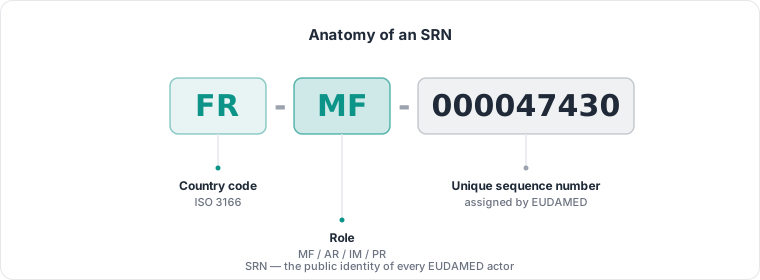
An SRN looks like FR-MF-000047430. It is built from three parts:
- Country code — the ISO 3166 alpha-2 code of the country whose competent
authority validated the actor (here
FR, France). - Role code — the actor's role:
MF(manufacturer),AR(authorised representative),IM(importer) orPR(producer of systems or procedure packs). - A unique sequence number — assigned by the system.
That middle segment is the part most people miss. The role is baked into the
identity itself, so an SRN tells you not just who the actor is but what they
are allowed to do. An importer's SRN starts with IM; you should never see a
device's legal manufacturer carrying one. If you are checking a supplier, the
role code is the first sanity check.
Who needs an SRN
Four roles register and receive an SRN:
- Manufacturers — the legal entity responsible for the device. They make up the largest group; you can explore the indexed manufacturers here.
- Authorised representatives — the EU-based legal presence for a non-EU manufacturer.
- Importers — the operator placing a third-country device on the EU market.
- System and procedure-pack producers — actors assembling CE-marked devices into a system or kit.
Distributors do not receive an SRN; they have lighter obligations and are not registered as actors in the same way.
How to verify a manufacturer in seconds
The official EUDAMED portal works, but it is slow and unforgiving if you do not already know the exact SRN. The practical workflow most people want is "I have a company name, is it real and registered?" That is exactly what a search-first index is for:
- Search the company name across all indexed actors.
- Confirm the role code in the SRN matches what you expect (a manufacturer
should be
MF). - Confirm the country matches the registered address.
- Cross-reference the devices and certificates linked to that SRN.
If a "manufacturer" has no SRN, or the SRN role code says IM, that is a red
flag worth a second look. France alone accounts for 3,053 of the actors we have
indexed — a reminder that even a single national market is large enough that
manual verification on the raw portal quickly becomes painful.
Why the SRN matters beyond compliance
For regulatory-affairs teams, the SRN is the join key that makes EUDAMED data usable. Every device record, every notified-body certificate, every future vigilance signal points back to an SRN. Once you have it, you can follow an organisation's entire regulatory footprint: its device portfolio, the risk classes it operates in, and the certificates underpinning its CE marks. That is the difference between a database and an investigation tool.
The SRN is deliberately boring — a stable, public, structured identifier. But that boring stability is precisely what makes EUDAMED auditable, and what lets a buyer, a hospital procurement team or a competitor confirm in seconds something that used to require a phone call and a leap of faith.
Start from the actor, read the SRN, follow it to the devices. Once that becomes muscle memory, verifying any company in the EU medical-device market is a 30-second job rather than an afternoon.
Reviewed by a regulatory-affairs expert

Anis Ben Brahim
Biomedical Expert · Regulatory Affairs MD — Quality Assessor for Medical Devices, National Agency for Medicines & Health Products (ANMPS), Tunisia
 ANMPSRegulatory authority