How are in vitro diagnostics classified under the IVDR (classes A–D)?
Kevin Mandrick · Published Jun 15, 2026 · Last reviewed Jun 10, 2026
Under the In Vitro Diagnostic Regulation (Regulation (EU) 2017/746, the "IVDR"), every in vitro diagnostic medical device is sorted into one of four risk classes — A, B, C or D, from lowest to highest risk — using the classification rules in Annex VIII of the regulation. Class A covers the lowest-risk products (general laboratory instruments, buffers, specimen receptacles); class D covers the highest-risk ones (tests used to screen blood and organ donations for transmissible agents such as HIV or hepatitis). The class a device falls into determines how rigorous its conformity assessment must be and whether a notified body has to be involved at all.
This is the single biggest change the IVDR brought over the old IVD Directive: the directive listed only a handful of high-risk diagnostics by name and treated almost everything else as self-certified, whereas the IVDR applies a rule-based, risk-tiered system to the whole field. The practical effect is that the large majority of in vitro diagnostics now sit in a defined class with defined obligations.
What each IVDR class means
Annex VIII works through seven classification rules; applied to a device's intended purpose, they place it in exactly one class. In plain terms:
- Class A — lowest risk. General laboratory products with no critical diagnostic role on their own: instruments, specimen receptacles, wash buffers, general culture media. Most class A devices are self-certified by the manufacturer; the exception is sterile class A devices, where a notified body reviews the sterility aspects.
- Class B — low-to-moderate risk. The default tier for devices not caught by a higher rule — for example self-tests such as pregnancy or cholesterol tests, which Annex VIII places in class B, and many routine analytes.
- Class C — moderate-to-high risk. Diagnostics whose result drives a serious clinical decision: cancer markers, companion diagnostics that decide a therapy, genetic tests, infectious-disease tests outside the class D category, and blood-grouping reagents below the donation-screening tier.
- Class D — highest risk. Tests used to detect transmissible agents in blood, tissue, organ or cell donation, or to detect agents that cause a life-threatening disease with a high risk of propagation. HIV, hepatitis B/C and similar donation-screening assays are the textbook examples.
The dividing line that matters most for the obligations that follow is the one between class A (largely self-certified) and classes B, C and D, where a notified body — identified by its four-digit identification number — must be involved in the conformity assessment under Annex IX to XI. The higher the class, the deeper that assessment goes, and for class D it extends to batch verification and EU reference laboratory testing.
How IVDR devices break down in EUDAMED
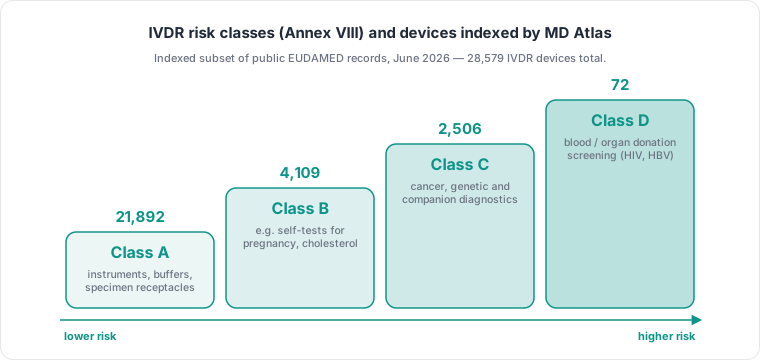
The theory is one thing; the shape of the real market is another. As of June 2026, MD Atlas has indexed 28,579 devices registered under the IVDR. That is an indexed subset of the public EUDAMED records — a large and growing slice, not the complete back-office dataset the Commission maintains — but it is enough to show how the four classes actually distribute. By class:
- Class A — 21,892 devices, roughly three-quarters of all indexed IVDR devices.
- Class B — 4,109 devices.
- Class C — 2,506 devices.
- Class D — 72 devices.
The distribution is steeply pyramidal: class A alone accounts for about 77% of the indexed IVDR population, while class D — the most heavily regulated tier — is barely a quarter of one percent of it. That matches the regulation's intent. Most of what a clinical laboratory handles is supporting hardware and reagents, and only a small core of assays carries population-level risk. It also explains why notified-body capacity for IVDs has been such a bottleneck: the small class C and class D populations are precisely the devices that cannot be self-certified, so they compete for a limited pool of designated bodies.
Alongside the IVDR devices, MD Atlas still indexes 9,613 devices registered under the legacy IVD Directive. Those legacy registrations are gradually being re-classified and re-registered under the IVDR's rules during the transition period, which is part of why the IVDR class A figure keeps climbing.
Why classification is the first thing to check
For anyone doing due diligence on an in vitro diagnostic — a procurement team, a distributor vetting a supplier, a competitor mapping a segment — the class is the fastest read on the regulatory burden behind a product. A class D assay carries obligations that a class A buffer simply does not, and a manufacturer claiming a class C companion diagnostic should have a notified-body certificate to match.
A few starting points to explore the data yourself:
- Every IVDR device indexed, filterable by class, country and EMDN nomenclature.
- All registered economic operators, where each manufacturer carries its EUDAMED Single Registration Number (SRN).
Cross-checking the declared class against the device's intended purpose — and against whether a notified body was involved at all — is exactly the kind of sanity check the IVDR's risk tiers were designed to make possible. The official position always rests with the European Commission's EUDAMED portal and the regulation text on EUR-Lex; MD Atlas just makes the classification visible across the whole indexed population in seconds.
A diagnostics reviewer's lens
The class is not a label the manufacturer is free to choose — it is the output of applying the Annex VIII rules to the device's intended purpose. Most classification disputes in practice are arguments about intended purpose: a test marketed for a class C use (say, a companion diagnostic) cannot be registered as class B just because an earlier version of it was. When a registered class looks too low for what the device claims to do, that mismatch is the thread worth pulling — and it is visible at a glance once every IVDR device sits in one searchable list.
Reviewed by a regulatory-affairs expert

Henri Bendelac
Medical Director, Medical Affairs Europe — clinical and medical-affairs leadership in the medical-device sector