Which notified bodies issue the most MDR certificates?
Kevin Mandrick · Published Aug 12, 2026 · Last reviewed Aug 7, 2026
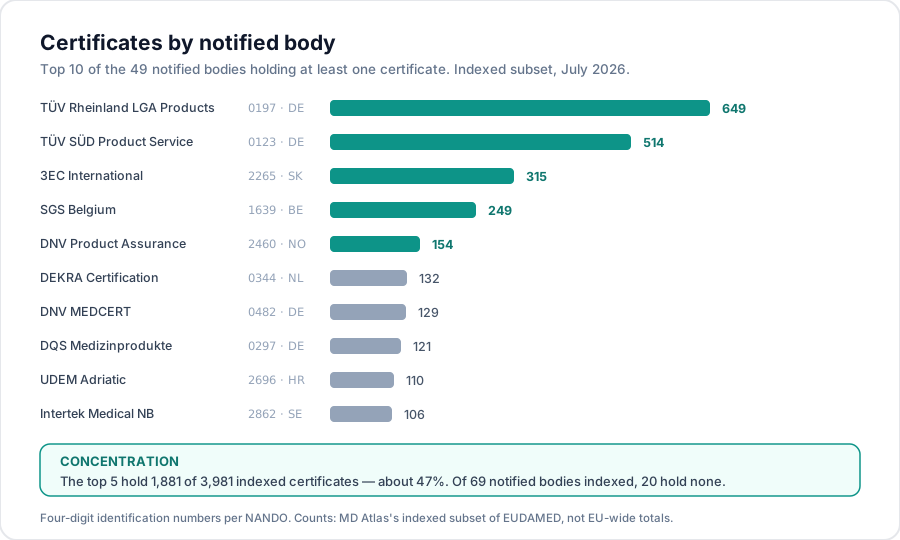
Two German bodies hold more than a quarter of all the certificates in our index. Counting the certificate records in MD Atlas's indexed subset of EUDAMED, TÜV Rheinland LGA Products (NANDO 0197) holds 649 and TÜV SÜD Product Service (0123) holds 514 — 1,163 of 3,981 between them. The top five bodies hold 1,881, about 47%. If you have ever wondered why notified-body capacity is a recurring topic at every MDR conference, that distribution is the reason.
What "most active" means here
A word on the measurement before the ranking, because the phrasing matters. What is counted below is certificate records recorded in EUDAMED and indexed by MD Atlas, attributed to the notified body that issued them. Notified bodies issue certificates; EUDAMED records them. A body with a low count is not necessarily a small body — it may be newly designated, may have a narrow scope, or may simply have uploaded less of its back catalogue, since notified bodies have until 27 May 2027 to enter certificates issued before their module became mandatory.
So read the table as what is on the public record today, not as a definitive market share.
The ranking
| Notified body | ID | Country | Certificates |
|---|---|---|---|
| TÜV Rheinland LGA Products | 0197 | DE | 649 |
| TÜV SÜD Product Service | 0123 | DE | 514 |
| 3EC International | 2265 | SK | 315 |
| SGS Belgium | 1639 | BE | 249 |
| DNV Product Assurance | 2460 | NO | 154 |
| DEKRA Certification | 0344 | NL | 132 |
| DNV MEDCERT | 0482 | DE | 129 |
| DQS Medizinprodukte | 0297 | DE | 121 |
| UDEM Adriatic | 2696 | HR | 110 |
| Intertek Medical Notified Body | 2862 | SE | 106 |
You can open any of these directly — for instance TÜV Rheinland LGA Products (0197) or SGS Belgium (1639) — and page through the certificates recorded against each. Every one carries the four-digit identification number that is the body's real identity: names change with corporate restructuring, the number does not.
Three things the distribution tells you
It is a long tail with a very short head. Of the 69 notified bodies in our index, 49 hold at least one certificate — meaning 20 currently hold none on the public record. Below the top ten, counts fall away quickly. When people say "notified-body capacity is the bottleneck", this shape is the evidence: the manufacturers queueing are mostly queueing for the same few doors.
Germany is over-represented, but not alone. Four of the top ten are German. Yet the list also runs through Slovakia, Belgium, Norway, the Netherlands, Croatia and Sweden — and the designations behind them are national decisions, not a German monopoly. Notified bodies are designated and monitored by the authority responsible for notified bodies in their member state, under Article 35 of the MDR (Regulation (EU) 2017/745), against the requirements in Annex VII. Designation is scope-limited: a body is designated for specific device types and conformity-assessment activities, not for "medical devices" in general.
IVDR capacity is a different, much thinner market. Of the certificates in our index, 3,695 sit under the MDR and only 286 under the IVDR (Regulation (EU) 2017/746). Among the 69 bodies indexed, only 11 show any IVDR designation at all — nine of which also cover the MDR. If you make in-vitro diagnostics, your realistic choice set is dramatically smaller than the headline number of notified bodies suggests.
What this means when you are choosing one
Concentration is not, by itself, a reason to avoid the big bodies. But it does change the questions worth asking.
- Check scope before capacity. A body must be designated for your device codes and your conformity-assessment route. A large body with the wrong scope is no use; a smaller one with exactly your scope may be a faster route. Confirm the designation in the Commission's NANDO database, which is the authoritative record of what each body is designated for.
- Read the numbers as lead-time signals, not quality signals. A high certificate count means a body has been actively certifying — it does not mean it has room for you next quarter, and a low count does not mean poor quality.
- Look at who already certifies devices like yours. This is the practical use of the public record: search the indexed certificate corpus and see which body signed off on comparable devices, then work back to the manufacturers and the devices themselves. A body that has already assessed your device family knows the state of the art in it.
- Watch for a change of body. If a device's certificate moves from one notified body to another, that is a real signal — sometimes benign (a designation lapse on the old body's side), sometimes not. The certificate record is where you see it — and for a legacy device under the Article 120 transition, the body named in the written agreement is the one now watching it.
The honest limits of this reading
Three caveats, all of which matter more than the ranking itself.
First, MD Atlas indexes a subset of EUDAMED, not the complete database, so these are indexed counts as of July 2026 rather than EU-wide totals. Second, the backlog is still loading: with the 27 May 2027 deadline for pre-existing certificates still ahead, a body that has uploaded diligently looks larger than one that has not, independent of how much certifying either has done. Third, a certificate count says nothing about what was certified — one QMS certificate covering a broad scope and one technical-documentation certificate for a single device family both count as one.
The ranking is a starting point for a conversation with your notified body, not a substitute for one.
Reviewed by a regulatory-affairs expert

Anis Ben Brahim
Biomedical Expert · Regulatory Affairs MD — Quality Assessor for Medical Devices, National Agency for Medicines & Health Products (ANMPS), Tunisia
 ANMPSRegulatory authority