UDI-DI vs UDI-PI: the two halves of a device UDI, explained
Kevin Mandrick · Published Jul 10, 2026 · Last reviewed Jul 9, 2026
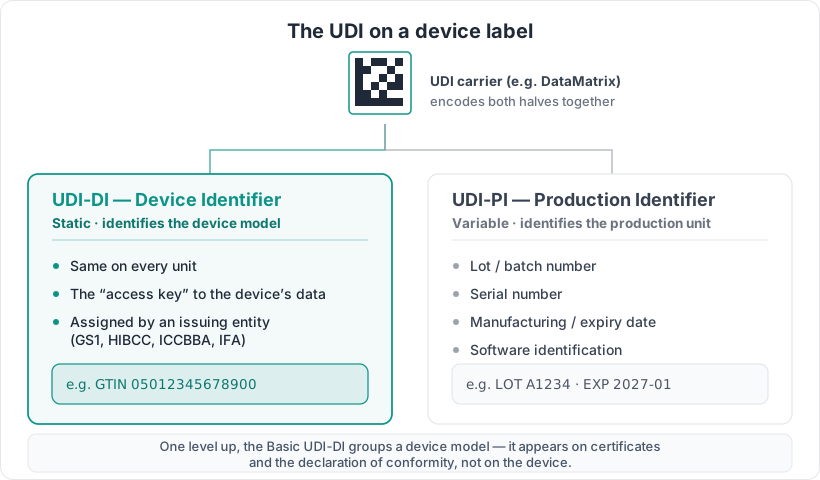
A device's UDI is made of two parts: the UDI-DI, which identifies the device model, and the UDI-PI, which identifies the production unit. The UDI-DI is static — the same on every unit of that model. The UDI-PI is variable — it carries the lot number, serial number, or dates that change from one production run to the next. Both are encoded together in the UDI carrier on the label. That is the whole distinction; the rest is detail.
Under Article 27 of the Medical Device Regulation (Regulation (EU) 2017/745, "MDR"), the Unique Device Identification system produces a UDI that "comprises" a UDI-DI and, where applicable, a UDI-PI. Annex VI Part C puts it plainly: "The UDI is comprised of the UDI-DI and the UDI-PI."
The UDI-DI: the static device identifier
The UDI-DI (UDI Device Identifier) is a unique code "specific to a model of device," and Annex VI Part C calls it the "access key" to information stored in a UDI database. It is the stable part: every unit of the same model, version and packaging level carries the same UDI-DI. You only get a new UDI-DI when the device materially changes in a way that could cause misidentification — a new name, version or model, a change in sterile packaging or required pre-use sterilisation, package quantity, or a critical warning or contra-indication.
The UDI-DI is not "issued by EUDAMED." It is assigned under the rules of a Commission-designated issuing entity — there are four: GS1, HIBCC, ICCBBA and IFA (European Commission, UDI overview). If a manufacturer uses GS1, its GS1 product number (the GTIN) serves as the UDI-DI. EUDAMED then registers and publishes the device record that the UDI-DI points to — the issuing entity assigns the number, the database stores it.
The UDI-PI: the variable production identifier
The UDI-PI (UDI Production Identifier) "identifies the unit of device production." Annex VI Part C lists exactly what it can comprise:
- a lot or batch number,
- a serial number,
- a manufacturing date and/or an expiry date,
- software identification (for software as a medical device).
It is the variable part — the data that differs unit to unit or batch to batch. A useful rule from Annex VI Part C: if a lot number, serial number, software identification or expiry date appears on the label, it must be part of the UDI-PI. Because it tracks production, the UDI-PI is carried on the physical product and its packaging; the device record submitted to the UDI database is keyed to the UDI-DI and the core data elements that go with it (MDR Article 27(3)), not to a per-unit UDI-PI entry.
How they sit together — a worked example
Illustrative only — not a real device record.
Take "Model X urinary catheter, 6 Fr":
- UDI-DI (static): the GTIN
05012345678900— identical on every Model X catheter, and the key to its data. - UDI-PI (variable):
lot A1234,expiry 2027-01, and — if the device is serialised —serial 0009. Different across batches. - On the label: both are encoded together in the UDI carrier (a DataMatrix, linear barcode or RFID tag), with a human-readable line beneath.
Where the Basic UDI-DI fits
One level up sits the Basic UDI-DI — "the primary identifier of a device model" and "the main key for records in the UDI database," referenced on certificates and the EU declaration of conformity. It is not on the device or its carrier. The hierarchy is: Basic UDI-DI groups a model → each UDI-DI identifies a specific packaging of that model → the UDI-PI identifies the production unit. (Note the two distinct "access key" roles: the UDI-DI is the access key to a UDI database record, while the Basic UDI-DI is the main key in EUDAMED — different levels.) We cover that grouping key in Basic UDI-DI vs UDI-DI.
Seeing it in the data
Every device registered in EUDAMED carries a UDI-DI, and that is the identifier you search on. As of June 2026 MD Atlas has indexed 1,752,505 devices — an indexed subset of the public data, not the complete database. You can search a device by name, brand or UDI to open its record, or look up the manufacturer that registered it. The UDI-DI is the stable handle that ties a product on a shelf to its regulatory record; the UDI-PI is what tells you which unit you are holding.
The short version: UDI-DI = which model; UDI-PI = which production unit. One is fixed and identifies the device; the other varies and identifies the lot, serial or dates. Together they are the UDI.
Reviewed by a regulatory-affairs expert

Audrey Gilbert
Doctor of Pharmacy — expert Quality & Regulatory Affairs consultant in healthcare, helping companies secure and grow their activities
Agila Conseil