What is an EMDN code? The EU device nomenclature, decoded
Adrien Lemaire · Published Aug 5, 2026 · Last reviewed Aug 4, 2026
An EMDN code is the European Medical Device Nomenclature term that says what a device is — a peripheral I.V. catheter, a hip prosthesis, a blood-collection bag. It is attached to each UDI-DI when a manufacturer registers a device in EUDAMED, it is free to use, and it is the handle you reach for when you want to see every device of a given kind rather than every device from a given company. Here is how the code is built, how to read one, and what it does and does not tell you.
Where the EMDN comes from
The nomenclature is required by the regulations themselves: Article 26 of the MDR (Regulation (EU) 2017/745) and Article 23 of the IVDR (Regulation (EU) 2017/746) oblige the Commission to make a medical device nomenclature available free of charge, so that EUDAMED has a common vocabulary for describing devices. The Commission's answer was the EMDN, built on the Italian Ministry of Health's Classificazione Nazionale Dispositivi medici (CND) — a nomenclature already in national use before it was adopted at EU level.
Two consequences follow from that origin. First, the EMDN is free: the Commission publishes the full nomenclature to all stakeholders at no cost, which is a deliberate contrast with licensed nomenclatures. Second, it is clinical, not regulatory — the terms describe what a product is, in the vocabulary of the people who use it, not what regulatory regime it falls under.
How the code is built
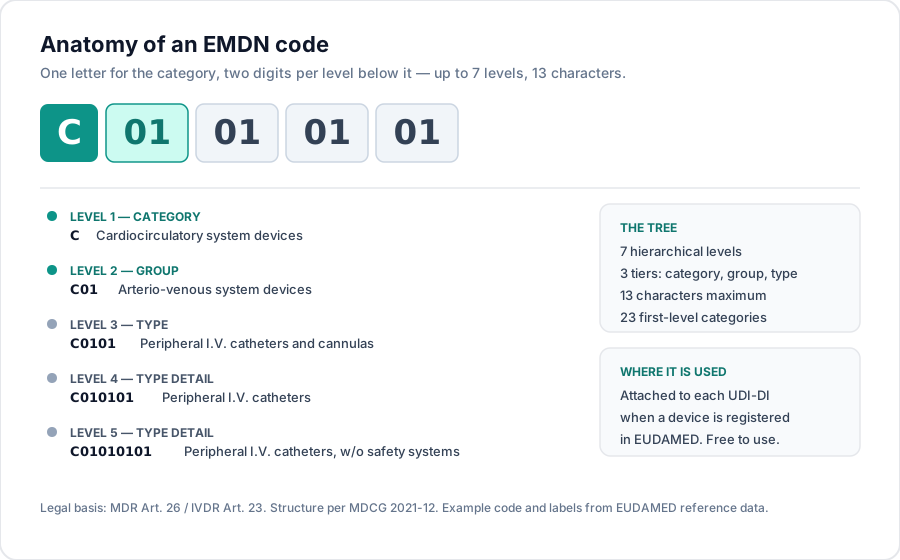
The EMDN is an alphanumeric, seven-level hierarchical tree, clustered into three tiers — categories, groups and types — as set out in the Commission's guidance (MDCG 2021-12, FAQ on the EMDN). A code begins with a letter naming the category, then adds two digits per level as you descend, up to a maximum of 13 characters.
Read left to right, C01010101 unpacks like this:
| Code | Level | Meaning |
|---|---|---|
C | Category | Cardiocirculatory system devices |
C01 | Group | Arterio-venous system devices |
C0101 | Type | Peripheral I.V. catheters and cannulas |
C010101 | Type detail | Peripheral I.V. catheters |
C01010101 | Type detail | Peripheral I.V. catheters, without safety systems |
Because the code is a prefix tree, every level is also a filter. C is every
cardiocirculatory device; C0101 is every peripheral I.V. catheter and cannula.
That is what makes the EMDN useful for market analysis in a way a flat list of
product names never is — you choose how coarse or how fine you want to look.
What the 23 categories cover
The tree's first level is a set of 23 letters, and it is worth knowing that
they are not a tidy A-to-W run: E, I and O are unused. The letters range from
A (devices for administration, withdrawal and collection) through J
(active-implantable devices), Q (dental, ophthalmologic and ENT devices) and W
(in vitro diagnostic medical devices), to Z (medical equipment, accessories,
software and consumables). Two categories are worth flagging because people miss
them: W is where in-vitro diagnostics live, and X covers products
without an intended medical purpose — the Annex XVI list.
MD Atlas's indexed tree carries 8,516 EMDN terms across those 23 categories, harvested from EUDAMED's own reference data. Counting the device records in our indexed subset of EUDAMED — about 2.5 million, not the complete database — the categories are wildly uneven:
| Category | Devices indexed |
|---|---|
Q — Dental, ophthalmologic and ENT | 404,862 |
P — Implantable prosthetic and osteosynthesis | 395,004 |
Y — Devices for persons with disabilities | 391,132 |
L — Reusable surgical instruments | 331,226 |
W — In vitro diagnostic devices | 112,143 |
J — Active-implantable devices | 261 |
The spread between Q at 404,862 and J at 261 is a genuine feature of the device
market, not an indexing artefact: active implantables are a small, high-risk,
low-volume family, while dental and ophthalmic consumables are registered in
enormous variety. You can walk any branch yourself — for instance the peripheral
I.V. catheters and cannulas under C0101, or
the whole indexed device corpus with the EMDN filter open.
What an EMDN code does not tell you
This is where the code is most often over-read.
- It is not a risk class. Classification under MDR Annex VIII (or IVDR Annex VIII) is driven by intended purpose, duration of contact and invasiveness — a rules-based exercise the manufacturer performs. Two devices sharing an EMDN term can sit in different risk classes, and the nomenclature never assigns one.
- It is not an identifier. The UDI-DI identifies a specific device model and the Basic UDI-DI groups a device family; the EMDN code describes a kind of device and is shared by every manufacturer making that kind. One EMDN term, many manufacturers.
- It is not a conformity route. Which notified body assessed the device, and under which annex, is recorded separately.
The practical framing: the UDI-DI answers which product is this, and the EMDN answers what sort of thing is it. You need both to move between a single record and the market around it.
Choosing the right code
Manufacturers assign the EMDN term themselves during registration, and the guidance is to pick the most specific term that fits the device's intended purpose — descend the tree as far as it will go rather than stopping at a comfortable mid-level term. If nothing fits, the nomenclature has a maintenance procedure for requesting a new term; the Commission publishes updated EMDN versions rather than letting national variants drift. Where a device could plausibly sit in two branches, the intended purpose decides, not the material or the shape.
Getting it wrong is not a minor filing detail. The code is what a competent authority, a hospital procurement team, or a post-market surveillance analyst uses to find devices like yours — a device filed under a vague parent term is effectively invisible to anyone searching the specific one.
Looking one up in MD Atlas
The EMDN tree is a first-class filter on device search: pick a branch and the
result set narrows to that prefix and everything below it. Because the filter is a
prefix match on the code's ancestors, selecting C01 returns C0101, C010101
and every leaf beneath — you do not have to enumerate the children.
From a category you can go sideways as well as down: open any device in the result set and you reach its manufacturer, its Basic UDI-DI family, and the certificates recorded in EUDAMED for it. That is the loop the nomenclature was designed to support — start from what kind of device, end at which company makes it, and is it registered.
One honest caveat, worth repeating: MD Atlas indexes a subset of EUDAMED, not the complete database, so the per-category counts above are our indexed figures as of July 2026 rather than EU-wide totals. The shape of the distribution is stable; the absolute numbers move as ingestion continues.
Reviewed by a regulatory-affairs expert

Audrey Gilbert
Doctor of Pharmacy — expert Quality & Regulatory Affairs consultant in healthcare, helping companies secure and grow their activities
Agila Conseil