What is a UDI carrier? Formats, placement, and the Class I deadline
Kevin Mandrick · Published Jul 15, 2026 · Last reviewed Jul 14, 2026
A UDI carrier is the physical mark that puts the UDI onto a device — the barcode, DataMatrix or RFID tag you see on the label. It is not the identifier itself; it is the means of conveying it. Under the EU Medical Device Regulation, Annex VI Part C defines it precisely: "The UDI carrier is the means of conveying the UDI by using AIDC and, if applicable, its HRI. UDI carriers include, inter alia, ID/linear bar code, 2D/Matrix bar code, RFID." In short: the UDI is the number; the carrier is how that number gets onto the product.
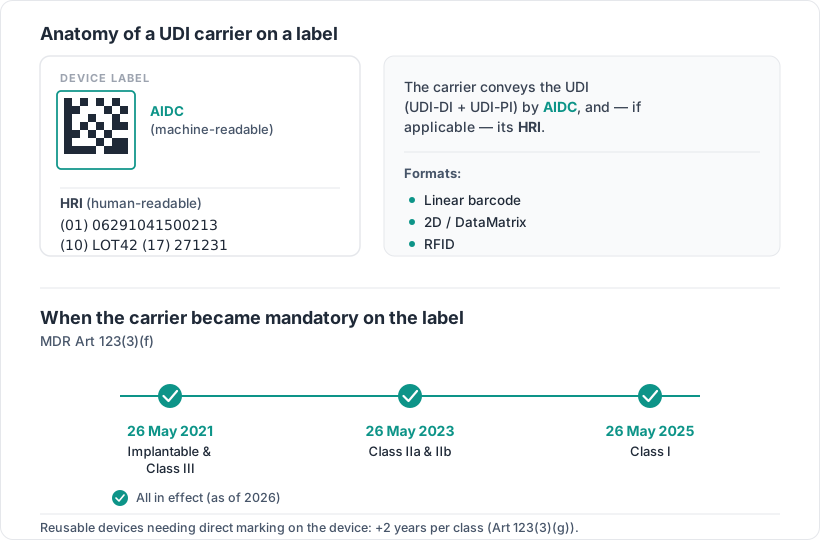
AIDC and HRI: the two forms on the carrier
A carrier conveys the UDI in up to two representations:
- AIDC (Automatic Identification and Data Capture) — the machine-readable form: the linear barcode, 2D/DataMatrix or RFID a scanner reads.
- HRI (Human Readable Interpretation) — the plain-text characters a person can read, printed alongside the AIDC.
By default both appear on the label. Annex VI Part C allows one narrow exception: if there are "significant constraints limiting the use of both AIDC and HRI on the label, only the AIDC format shall be required" — except for devices used outside healthcare facilities (home-care), where the HRI must still appear even if that leaves no room for the AIDC.
What the carrier encodes
The carrier conveys the whole UDI, which "is comprised of the UDI-DI and the UDI-PI" — the device identifier (which model) and the production identifier (which lot, serial or dates). Both are encoded together in the one carrier. The carrier itself is built to the standard of the manufacturer's issuing entity — for a GS1 user, a GS1 DataMatrix. Note the three distinct steps that often get blurred: the issuing entity assigns the UDI, EUDAMED registers the device record, and the manufacturer places the carrier on the label. EUDAMED does not "issue" the carrier; it stores the record the carrier points to.
Where the carrier must go
Placement is set by Article 27(4) of the Regulation (EU) 2017/745 (MDR): "UDI carriers shall be placed on the label of the device and on all higher levels of packaging. Higher levels of packaging shall not be understood to include shipping containers." So the carrier goes on the device label and every level of packaging up to — but not including — the shipping container.
When it became mandatory — the deadlines
The duty to place a UDI carrier on the label phases in by risk class under Article 123(3)(f), and as of 2026 all three dates have passed:
- Implantable and class III devices — since 26 May 2021;
- Class IIa and class IIb devices — since 26 May 2023;
- Class I devices — since 26 May 2025.
In other words, the UDI carrier on the label is now required across every risk class, class I included. (You can read the official roll-out in the European Commission's UDI FAQ.)
A separate, later obligation covers direct marking: reusable devices that need cleaning, disinfection or sterilisation between patient uses must bear the carrier on the device itself, permanent and readable after each reprocessing cycle (Annex VI Part C, §4.10). Those dates run two years behind the label dates per class under Article 123(3)(g) — so class I direct marking applies from 26 May 2027. We cover that in the direct-part-marking guide.
From the carrier back to the record
The point of the carrier is the round trip: scan the DataMatrix, read the UDI-DI, and look up the device's regulatory record. As of June 2026 MD Atlas has indexed 1,752,505 devices — an indexed subset of the public data, not the complete database. You can search a device by its UDI or name to open its record, or look up the manufacturer behind it. For the two parts the carrier encodes, see UDI-DI vs UDI-PI.
The short version: the UDI carrier is the mark, not the number — AIDC plus, where it fits, HRI; on the label and every packaging level below the shipping container; mandatory for every class since 26 May 2025.
Reviewed by a regulatory-affairs expert

Audrey Gilbert
Doctor of Pharmacy — expert Quality & Regulatory Affairs consultant in healthcare, helping companies secure and grow their activities
Agila Conseil