Is EUDAMED public? How to access and search it without a login
Adrien Lemaire · Published Jul 8, 2026 · Last reviewed Jul 3, 2026
Yes — EUDAMED is public. The European database on medical devices has a public website that anyone can search with no account, no login, and no registration. You only need to sign in if you are a manufacturer, importer, authorised representative or other economic operator who has to submit data. To simply look up a device, a manufacturer, a notified-body certificate or a UDI, you open the public site and search — that is it.
The confusion is understandable. A common search is "EUDAMED connexion" or "EUDAMED login," which makes it sound like a gated portal. It is not. There are two front doors, and only one of them asks who you are.
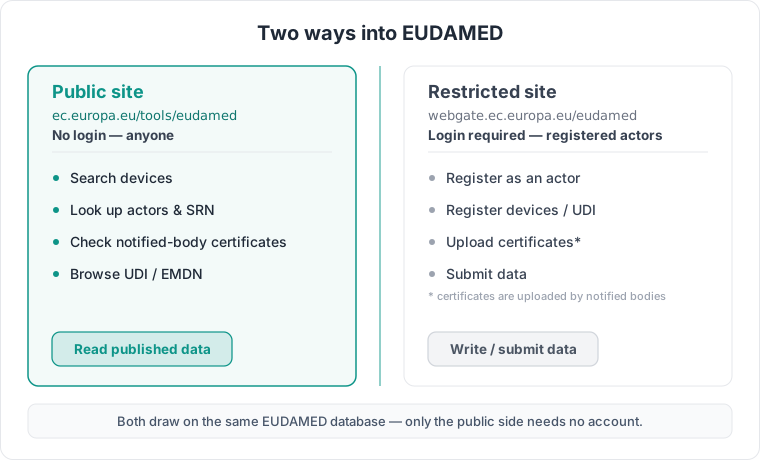
The two doors: public vs restricted
EUDAMED is built around six interconnected modules plus a public website, and the European Commission exposes it through two URLs:
- The public site — ec.europa.eu/tools/eudamed — is open to the general audience. No login. You can search and read the data that has been published.
- The restricted site —
webgate.ec.europa.eu/eudamed— is for authorised users. This is where an economic operator signs in (via EU Login, with an approved EUDAMED actor account) to enter data: register as an actor, register devices and UDIs, or where a notified body uploads certificate information.
So the honest answer to "do I need a EUDAMED login?" is: no, not to search — yes, only if you are an actor submitting data. A hospital, a procurement team, a journalist, a competitor or a curious member of the public can all browse the public site freely; none of them can register anything, because writing data is the part that requires an approved account. (Registering an actor is also how the SRN, the Single Registration Number, gets assigned — see the Actor registration module.)
The law that makes it public
EUDAMED's public access is not a courtesy — it is written into the regulation. Article 33 of the Medical Device Regulation (Regulation (EU) 2017/745, "MDR") establishes EUDAMED, and its very first stated purpose is "to enable the public to be adequately informed about devices placed on the market, the corresponding certificates issued by notified bodies and about the relevant economic operators." The same article requires the Commission to ensure the public parts are presented "in a user-friendly and easily-searchable format." Article 34 governs EUDAMED's functionality and the audited path to full operation. Public access, in other words, is one of the database's reasons to exist.
What is actually public — module by module
Not every module is live, and not everything inside a live module is published to the public. As of mid-2026, after the Commission's notice published on 27 November 2025 (Commission Decision (EU) 2025/2371 of 26 November 2025) triggered a six-month transition under Regulation (EU) 2024/1860, four modules became mandatory on 28 May 2026:
- Actor registration — manufacturers, authorised representatives, importers and system/procedure-pack producers, each identified by their SRN;
- UDI / Device registration — devices and their unique device identifiers;
- Notified Bodies and Certificates — the four-digit notified bodies and the certificate information associated with them;
- Market Surveillance — used by competent authorities and the Commission; its content is not published to the public.
The remaining two modules — Vigilance and post-market surveillance and Clinical Investigations and performance studies — are a later tranche, still in development or under analysis, and were not part of the 28 May 2026 mandatory set. The European Medical Devices Nomenclature (EMDN) that classifies every device is fully available on the public site, too. (You can read the official rollout note on the four first mandatory modules.)
Because mandatory registration only began in May 2026, the public dataset has been filling in over time rather than arriving complete — a direct consequence of that timeline, not a flaw in the search itself.
Searching the public data, faster
The public EUDAMED site answers the "can I see it?" question. The harder question is "can I find what I need quickly?" — across more than a million device records, that is where the search experience matters. MD Atlas indexes EUDAMED's public data and puts a fast search in front of it. As of June 2026 we have indexed 1,752,505 devices — an indexed subset of the public data, not the complete database — alongside the manufacturers and other actors that registered them and the notified-body certificates associated with those devices.
Three quick ways to use it:
- To check a product, search by device, brand or UDI and open its record.
- To vet a supplier, look up the manufacturer or its SRN and see what it has registered.
- To start from scratch, run a free-text search and filter by country, risk class or EMDN category.
None of this replaces the official database — it reads the same public EUDAMED data — but it turns "is it in there?" into a question you can answer in seconds. And if you are still wondering what EUDAMED is in the first place, start with our explainer, What is EUDAMED?
The takeaway is simple: EUDAMED is public by design. You do not need a login to search it — only to register data in it. Open the public site, or search the indexed data here, and look.
Reviewed by a regulatory-affairs expert

Anis Ben Brahim
Biomedical Expert · Regulatory Affairs MD — Quality Assessor for Medical Devices, National Agency for Medicines & Health Products (ANMPS), Tunisia
 ANMPSRegulatory authority