UDI direct part marking: when the UDI must go on the device itself
Adrien Lemaire · Published Jul 17, 2026 · Last reviewed Jul 16, 2026
Most devices carry their UDI on the label. But a reusable device — a surgical instrument cleaned and sterilised between patients — has a label that does not survive. For those, the EU Medical Device Regulation requires the UDI carrier to go on the device itself: direct part marking (DPM). The mark must be permanent and stay readable after every reprocessing cycle, for the device's whole life. Here is when it applies, the deadlines, and the honest answer to the question RA teams actually ask — how do you mark a UDI onto a steel instrument.
The rule: a permanent, re-readable mark on the device
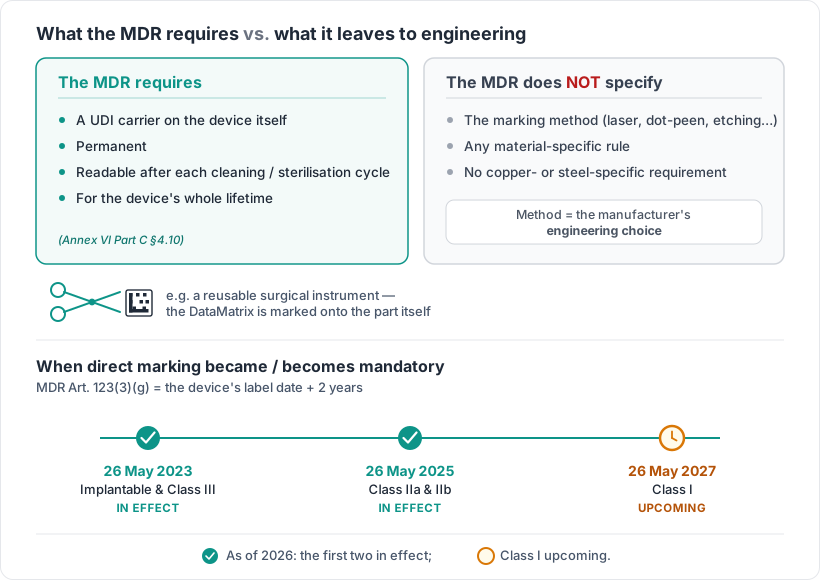
Annex VI Part C, §4.10, of Regulation (EU) 2017/745 (MDR) is explicit: "Devices that are reusable shall bear a UDI carrier on the device itself. The UDI carrier for reusable devices that require cleaning, disinfection, sterilisation or refurbishing between patient uses shall be permanent and readable after each process performed to make the device ready for the subsequent use throughout the intended lifetime of the device."
Read it in two tiers: any reusable device must bear a UDI carrier on the device itself; and when that device is reprocessed (cleaned, disinfected, sterilised or refurbished) between patient uses, the carrier must additionally be permanent and stay readable after every cycle, for the device's whole life. The classic case is a reprocessed reusable surgical instrument — forceps, scissors, clamps, retractors. The carrier still encodes the same UDI-DI and UDI-PI; it just lives on the metal instead of a paper label. The mark must remain accessible during normal operation or storage (§4.14), and there are narrow carve-outs — for example, if marking would interfere with the device's safety or performance, or is not technologically feasible.
The deadlines: two years behind the label dates
Direct marking phases in two years after the matching label-carrier date for each class, under Article 123(3)(g):
- Implantable and class III devices — since 26 May 2023;
- Class IIa and class IIb devices — since 26 May 2025;
- Class I devices — from 26 May 2027 (still upcoming as of 2026).
So for implantable, class III, class IIa and class IIb reusable devices the obligation is already live; class I reusable devices have until 26 May 2027 — the official dates are set out in the European Commission's UDI FAQ. (The label-carrier dates themselves are covered in What is a UDI carrier?.)
The honest answer on marking metal
Here is where searches like "UDI marking on stainless steel" or "marquage UDI cuivre" need a careful answer, because the regulation's silence is the point:
The MDR sets the requirement — permanence and readability after reprocessing — but it does not prescribe a marking method, and it sets no material-specific rule. There is no copper-specific or stainless-steel-specific UDI requirement in the regulation. How you achieve a permanent, re-readable mark on a given metal is an engineering question, not a regulatory one.
In practice, manufacturers mark instruments with a 2D DataMatrix using techniques such as laser etching/marking, dot-peen, or electrochemical etching, chosen so the mark survives repeated autoclaving and cleaning. Industry readability benchmarks like the GS1 DataMatrix symbol and the ISO/IEC 15415 and ISO/IEC 29158 print-quality / direct-part-mark grading standards are how a manufacturer demonstrates the mark stays scannable. None of those are mandated by material in the MDR — they are how you meet the regulation's "permanent and readable" bar on the metal you actually use. Treat the material question as a durability-and-grading problem, and do not expect (or invent) a rule that says "steel must be marked this way."
What stays the same — and where the data lives
Direct marking changes where the carrier sits, not what it represents or who does what. The issuing entity still assigns the UDI, the manufacturer applies the mark, and EUDAMED registers the device record — EUDAMED does not "issue" or generate the mark. The UDI-DI etched on the instrument is the same access key to its record that a labelled device carries.
You can see those records in the data: as of June 2026 MD Atlas has indexed 1,752,505 devices — an indexed subset of the public data, not the complete database. Search a device by its UDI to open its record, or look up the manufacturer behind a reusable instrument.
The short version: reusable, reprocessed devices must carry a permanent, re-readable UDI on the device itself — implantable/III/IIa/IIb already, class I from 26 May 2027. The MDR tells you the mark must last and stay readable; how you etch it into steel or any other metal is yours to engineer.
Reviewed by a regulatory-affairs expert

Audrey Gilbert
Doctor of Pharmacy — expert Quality & Regulatory Affairs consultant in healthcare, helping companies secure and grow their activities
Agila Conseil