Competent authorities for medical devices: who they are and how to find yours
Kevin Mandrick · Published Jul 20, 2026 · Last reviewed Jul 19, 2026
A competent authority (CA) is the national body each EU Member State puts in charge of enforcing the Medical Device Regulation on its territory — market surveillance, vigilance, registration oversight. It is a state authority, and it is not the same thing as a notified body (a private conformity-assessment organisation) or as EUDAMED (a database). Here is what a competent authority does, how to find the one for your country, and one point that trips people up: the designation of notified bodies does not live in EUDAMED.
What a competent authority does
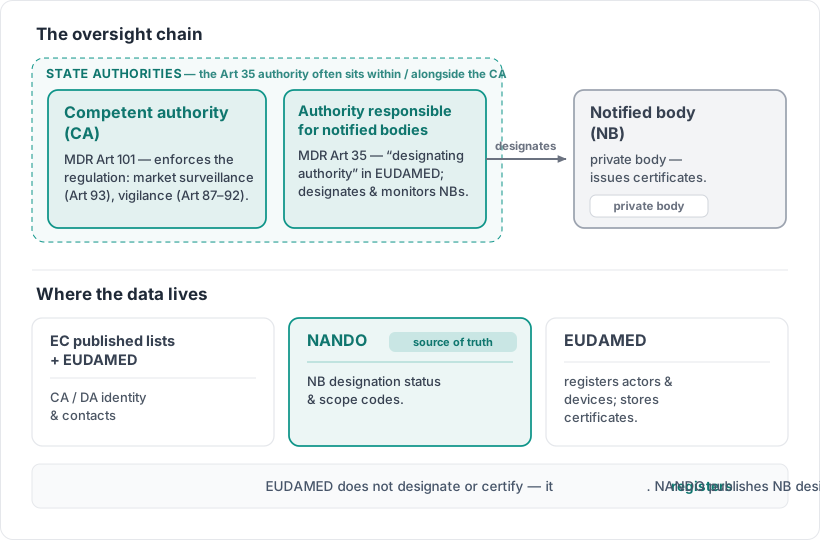
Article 101 of the Regulation (EU) 2017/745 (MDR) requires each Member State to "designate the competent authority or authorities responsible for the implementation of this Regulation," and to send their names and contact details to the Commission, "which shall publish a list of competent authorities." Article 101 establishes the authority; its actual duties are spread across the regulation — principally market surveillance under Article 93 (checking devices on the market) and vigilance across Articles 87 to 92 (the manufacturer reports serious incidents under Article 87; the competent authority analyses them under Article 89). In short, the CA is the public regulator: it does not issue CE certificates, but it polices the market, handles incidents, and oversees registration.
Competent authority vs the authority that designates notified bodies
There is a second, related role that is easy to confuse with the CA. Notified bodies are designated and monitored by a national "authority responsible for notified bodies" — that is the MDR's formal term, set out in Article 35. EUDAMED's own data labels these bodies "designating authorities" (DA), and the two terms point at the same function: assessing, designating and monitoring the notified bodies in that Member State. This authority is often part of, or sits alongside, the competent authority, but the job is distinct — the CA enforces the regulation generally; the Article 35 authority stands behind the notified bodies.
How to find the competent authority for a country
Two routes:
- The European Commission's published list. Because Article 101 requires the Commission to publish the competent authorities, the EC maintains a per-country list of national contact points for medical devices (European Commission — contacts), with separate lists for vigilance and clinical-investigation contacts.
- MD Atlas. EUDAMED publishes the competent and designating authorities through its actor data, and MD Atlas now surfaces them alongside the rest of the database. You can search companies and authorities to find a given country's authority and open its page.
Why notified-body designation lives in NANDO, not EUDAMED
This is the part worth getting right. Which notified body is designated, for which scope, by which Member State is published in the Commission's NANDO database (New Approach Notified and Designated Organisations), filterable by legislation — it is the source of truth for a notified body's designation status and scope codes (European Commission — notified bodies).
EUDAMED is not empty on notified bodies — it has a Notified Bodies and Certificates module that registers the NB as an actor and holds the certificates it issues. But the designation relationship — the authority-to-NB link and the scope a body is designated for — is a NANDO fact, not a EUDAMED one. So a complete check is a two-source job: NANDO for is this body designated and for what, EUDAMED for what has it registered and certified. EUDAMED itself never "designates" or "certifies" anything — the Article 35 authority designates, the notified body certifies, NANDO publishes, EUDAMED registers.
Seeing it in the data
MD Atlas indexes EUDAMED's public data — 1,752,505 devices as of June 2026, an indexed subset of the public data, not the complete database — plus the actors behind them and now the competent and designating authorities EUDAMED publishes. You can look up a device and trace it to its manufacturer, or search the authorities and companies for a country. For the certificates a notified body issues, see How to read a notified-body certificate in EUDAMED.
The short version: a competent authority is the national enforcer of the MDR (Article 101); the authority responsible for notified bodies (Article 35, the "designating authority" in EUDAMED) stands behind the notified bodies; and for whether a notified body is designated and for what scope, NANDO — not EUDAMED — is the source of truth.
Reviewed by a regulatory-affairs expert

Stéphanie Francart
Pharmacist — Quality Management Systems, Regulatory Conformity, Clinical Surveillance & Health Vigilance
STEP-ISO