Is EUDAMED mandatory now? The 2026 deadlines for lean regulatory teams
Kevin Mandrick · Published Jun 19, 2026 · Last reviewed Jun 18, 2026
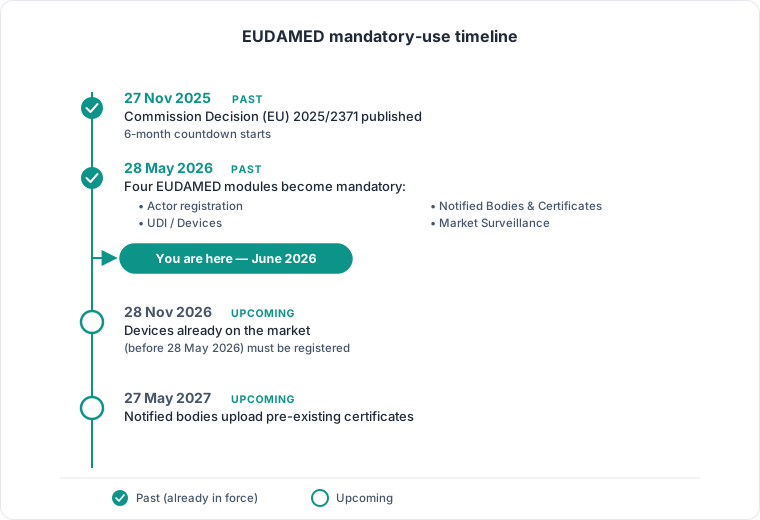
Yes. Since 28 May 2026, four modules of EUDAMED — the European Database on Medical Devices — are mandatory to use, not voluntary. If you place medical devices or in vitro diagnostics on the EU market, registering as an actor, registering your devices, and keeping that data current are now legal duties under the Medical Device Regulation (Regulation (EU) 2017/745, "MDR") and the In Vitro Diagnostic Regulation (Regulation (EU) 2017/746, "IVDR"). The switch was set by Commission Decision (EU) 2025/2371, published on 27 November 2025, which started a six-month countdown to mandatory use.
As of June 2026, MD Atlas has indexed 40,848 EUDAMED actors and 1,405,517 devices — an indexed subset of the public EUDAMED data at that date, not the complete database the Commission maintains. It is enough to check whether a given manufacturer, importer or device is already on the public record, which is exactly the question this deadline forces every regulatory team to answer.
What became mandatory on 28 May 2026
Four of EUDAMED's six modules crossed from voluntary to mandatory on that date, per the European Commission's announcement:
- Actor registration — every manufacturer, authorised representative, importer and system/procedure-pack producer must hold a registration and a SRN (Single Registration Number), assigned through the actor module under MDR Article 31.
- UDI / Device registration — devices, identified by their Basic UDI-DI and UDI-DI, must be registered before being placed on the market.
- Notified Bodies and Certificates — the notified-body certificates behind higher-risk devices are recorded here.
- Market Surveillance — the competent-authority oversight module.
The two remaining modules — Clinical Investigations / Performance Studies and Vigilance — are not yet in the mandatory set, so the obligations above are the ones that bite today.
The deadlines still ahead
The 28 May 2026 switch is the start line, not the finish. Two grace periods, set by Regulation (EU) 2024/1860, are still running:
- Devices already on the market. A device lawfully placed on the market before 28 May 2026 must still be entered into EUDAMED — within 12 months of the 27 November 2025 notice — the obligation biting from 28 November 2026. The mandatory date covers new placements; this period sweeps in the existing portfolio.
- Pre-existing notified-body certificates. Notified bodies have 18 months — until 27 May 2027 — to upload certificates issued before their module became mandatory.
Neither calendar date is printed on the Commission's own pages; both follow from the notice date plus the periods written into Regulation (EU) 2024/1860, so anchor your own plan to the regulation and confirm the arithmetic against your portfolio. The Commission's getting-ready guidance is the place to track any change.
It lands on top of the MDR and IVDR transition crunch
EUDAMED registration is not arriving in a quiet year. It is stacking on top of the legacy-device transition. Under Regulation (EU) 2023/607, MDR legacy devices may remain on the market only until 31 December 2027 (Class III and implantable Class IIb) or 31 December 2028 (other Class IIb, Class IIa, and Class I devices that are measuring, sterile or reusable surgical) — and only where the regulation's conditions are met. On the diagnostics side, Regulation (EU) 2024/1860 staggers the IVDR transition to 31 December 2027 (Class D), 31 December 2028 (Class C) and 31 December 2029 (Class B and sterile Class A).
Read together, the next thirty months ask a single QA/RA function to register actors and devices in EUDAMED, keep that data current, and move a legacy portfolio onto fresh MDR or IVDR certificates — frequently for the same products, on overlapping clocks.
What it means for under-staffed regulatory teams
This is the squeeze. The overwhelming majority of Europe's medical-device companies are small or medium-sized, and many run regulatory affairs with a handful of people — sometimes one. That same lean function now owns EUDAMED actor and device registration, the legacy re-certification programme, and the ongoing duty to keep records accurate. A missed registration is not a paperwork footnote: an unregistered actor or an unregistered device cannot be lawfully placed on the EU market, so the work sits directly on the revenue line.
It is why so many manufacturers — especially SMEs without a full regulatory department — are bringing in outside help to carry the load: an external Person Responsible for Regulatory Compliance (PRRC) under MDR Article 15, a fractional QA/RA lead, or a submission specialist for the registration backlog. MD Atlas is building a verified directory of QA/RA professionals for exactly this moment.
How to check your EUDAMED footprint in minutes
Before the deadlines, the fastest sanity check is to see what is already public. Working from the actor outward mirrors how the data hangs together:
- Find your company — or a supplier, importer or competitor — among all indexed actors, and note the SRN and role. You can narrow to, say, manufacturers registered in France.
- Review the devices linked to that actor and the risk classes they fall into, to see what still needs registering or re-certifying.
- Check the notified-body certificates that stand behind the higher-risk devices, and whether each is still valid.
Every figure MD Atlas shows is drawn from the public EUDAMED data and links back to the underlying record, read against that indexing scope. For the authoritative, real-time position on the rollout, the European Commission's EUDAMED portal remains the reference — but the deadlines are no longer hypothetical, and the teams that map their footprint now are the ones that will not be registering under pressure in November.
Reviewed by a regulatory-affairs expert

Anis Ben Brahim
Biomedical Expert · Regulatory Affairs MD — Quality Assessor for Medical Devices, National Agency for Medicines & Health Products (ANMPS), Tunisia
 ANMPSRegulatory authority