UDI vs GTIN: how your GS1 numbers map to the EU MDR UDI
Adrien Lemaire · Published Jul 13, 2026 · Last reviewed Jul 12, 2026
A GTIN and a UDI are not the same kind of thing. The UDI is a requirement of the EU Medical Device Regulation; the GTIN is a product number issued by GS1. They meet at one point: if you use GS1 as your identifier system, your GTIN becomes the device-identifier half of your UDI. So "UDI vs GTIN" is really "regulation vs the number that satisfies it." Here is exactly how the GS1 identifiers line up with the regulation.
UDI is the rule; GS1 is one way to satisfy it
Under Article 27 of the Medical Device Regulation (Regulation (EU) 2017/745, "MDR"), every device (other than custom-made and investigational ones) must carry a UDI built from codes issued by a Commission-designated issuing entity. There are four: GS1, HIBCC, ICCBBA and IFA (Commission Implementing Decision (EU) 2019/939, renewed to 2029). GS1 is the most widely used — but it is not the only one, so a device that uses HIBCC or ICCBBA will not have a GTIN at all. Everything below applies if you use GS1.
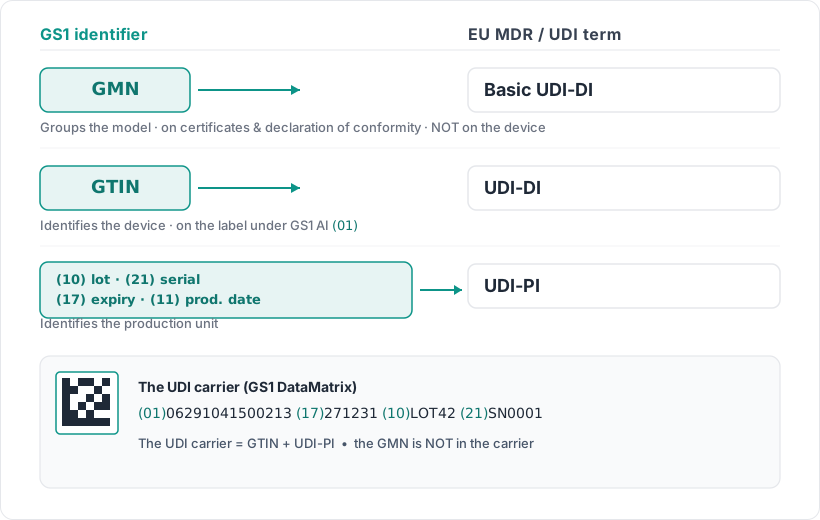
The GTIN is your UDI-DI
The UDI-DI is "a unique numeric or alphanumeric code specific to a model of device" and the "access key" to that device's record in a UDI database (MDR Annex VI Part C). When you use GS1, the GTIN is what fills that UDI-DI slot. The format and value of the GTIN are unchanged — the GTIN that identifies your trade item becomes the regulatory device identifier (you still assign a distinct GTIN per device model and variant, as GS1's rules require). In the UDI carrier it is introduced by GS1 Application Identifier (01).
The GTIN was not invented for the UDI; it is GS1's long-standing trade-item number, created for supply-chain and retail identification, that the MDR's UDI system reuses. And it is GS1 that assigns the number — EUDAMED and the UDI database register and store the device record the GTIN points to. EUDAMED does not "issue" a GTIN or a UDI; the issuing entity assigns, the database keys the record.
The GMN is your Basic UDI-DI
One level up from the GTIN sits the Basic UDI-DI — "the primary identifier of a device model" and "the main key for records in the UDI database," referenced on notified-body certificates and the EU declaration of conformity. Crucially, the European Commission's UDI guidance notes it "does not appear on any trade item" — it is a database and documentation key, not a mark on the box.
GS1's implementation of the Basic UDI-DI is the GMN (Global Model Number). A GMN is built from the manufacturer's GS1 Company Prefix, a model reference, and a mandatory two-character check pair that GS1's algorithm computes. So if you use GS1: your GMN is your Basic UDI-DI, grouping the model on your certificates and in EUDAMED; your GTIN is your UDI-DI, identifying the specific trade item.
Putting it together — a worked example
Illustrative only — the GS1 keys below are GS1's own published example values.
For one bandage model from a manufacturer that uses GS1:
- GMN = Basic UDI-DI:
1987654Ad4X4bL5ttr2310c2K— groups the model; appears on the certificate and declaration of conformity, not on the device. - GTIN = UDI-DI:
06291041500213— the device identifier, on the label, under AI(01). - UDI-PI (the production data): batch
(10), serial(21), expiry(17), production date(11)— GS1's "production date" is the MDR's manufacturing date.
Encoded together in the GS1 DataMatrix, the carrier reads, for example:
(01)06291041500213(17)271231(10)LOT42(21)SN0001. The (01) GTIN is the UDI-DI;
the (17) (10) (21) elements are the UDI-PI. The GMN is not in the carrier — it
lives in the paperwork and the database.
Seeing the identifiers in the data
Every device in EUDAMED is keyed by its UDI-DI — which, for GS1 users, is the GTIN you already know. As of June 2026 MD Atlas has indexed 1,752,505 devices — an indexed subset of the public data, not the complete database. You can search a device by its identifier to open its record, or look up the manufacturer behind it. For the two halves of the UDI itself, see UDI-DI vs UDI-PI; for the grouping key, Basic UDI-DI vs UDI-DI.
The short version: UDI is the regulation; GS1 gives you the numbers that fill it. Your GTIN is the UDI-DI, your GMN is the Basic UDI-DI, and your lot, serial and dates are the UDI-PI. Same numbers you already run — now doing regulatory work.
Reviewed by a regulatory-affairs expert

Audrey Gilbert
Doctor of Pharmacy — expert Quality & Regulatory Affairs consultant in healthcare, helping companies secure and grow their activities
Agila Conseil