MDR vs IVDR: which regulation applies to your product?
Kevin Mandrick · Published Jul 24, 2026 · Last reviewed Jul 19, 2026
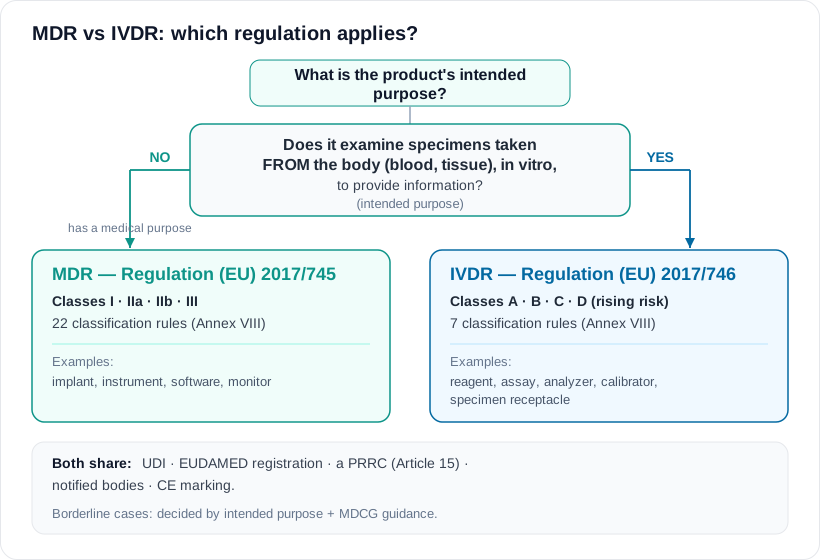
Two EU regulations govern devices, and which one applies to your product is decided by one thing: its intended purpose. The MDR (Regulation (EU) 2017/745) covers medical devices; the IVDR (Regulation (EU) 2017/746) covers in vitro diagnostic medical devices (IVDs). The short test: if your product's purpose is to examine specimens taken from the body — blood, tissue — in vitro, to provide information, it is an IVD under the IVDR. If it has a medical purpose but acts on or in the body (or is otherwise a medical device), it is under the MDR.
The definitions are the test
The regulations turn on their definitions. The MDR (Article 2(1)) defines a medical device as an article "intended by the manufacturer to be used … for human beings for one or more … specific medical purposes" — diagnosis, prevention, monitoring, prediction, prognosis, treatment or alleviation of disease, and so on — "and which does not achieve its principal intended action by pharmacological, immunological or metabolic means … in or on the human body."
The IVDR (Article 2(2)) defines an in vitro diagnostic medical device as a "medical device which is a reagent, … calibrator, control material, kit, instrument, apparatus, … software or system … intended by the manufacturer to be used in vitro for the examination of specimens … derived from the human body … solely or principally for the purpose of providing information" on a physiological or pathological state, a congenital condition, a predisposition, compatibility with recipients, treatment response, or to monitor therapeutic measures. Reagents, assays, calibrators, controls, specimen receptacles and the analysers that run on samples are IVDs.
The overlap that trips people up
Here is the subtlety worth getting right. The MDR's own definition (Article 2(1)) lists, among medical purposes, "providing information by means of in vitro examination of specimens." Read alone, that clause looks like it pulls in-vitro testing into the MDR. It does not — and the resolution is in the IVDR's wording itself: an IVD is "a medical device which is a reagent …" — that is, an IVD is a defined subset of medical device, and the IVDR is the specific regulation that governs that subset. So a product whose intended purpose is to provide information by examining specimens in vitro is regulated under the IVDR, despite the MDR's umbrella definition naming in-vitro examination. Same umbrella, more specific rulebook.
Classification differs on each side
Once you know which regulation applies, classification follows different schemes — both risk-based, both driven by intended purpose, both in Annex VIII:
- MDR: four classes — I, IIa, IIb, III (Article 51) — assigned by 22 classification rules. (Software is a frequent edge case: see MDR Rule 11.)
- IVDR: four classes — A, B, C, D (Article 47) — assigned by 7 classification rules. (How the A–D rules work: IVDR classification explained.)
So "class II" is meaningless without the regulation: an MDR class IIb device and an IVDR class C device are not on the same scale.
What the two regimes share
Picking the regulation does not change the toolkit. Both the MDR and the IVDR require a UDI, registration in EUDAMED, a PRRC (Person Responsible for Regulatory Compliance — Article 15 in each), assessment by a notified body above the lowest risk class, and CE marking. The structure is the same; the thresholds and annexes differ.
Borderline products — software, products combining functions, companion diagnostics — are resolved the same way: by intended purpose, with the Commission and the MDCG determining a product's regulatory status (MDR Article 4). Companion diagnostics, for instance, are IVDs under the IVDR, and their assessment additionally involves a medicines authority.
Seeing both in the data
MD Atlas indexes EUDAMED's public data across both regulations — as of June 2026, 1,752,505 devices, an indexed subset of the public data, not the complete database. You can search a device and read which regulation and class it falls under, or look up a manufacturer and see its MDR and IVDR products side by side.
The short version: intended purpose decides. Examine specimens from the body, in vitro, to inform → IVDR (classes A–D, 7 rules). A medical purpose otherwise → MDR (classes I–III, 22 rules). Everything downstream — UDI, EUDAMED, the PRRC, the notified body, CE marking — they share.
Reviewed by a regulatory-affairs expert

Henri Bendelac
Medical Director, Medical Affairs Europe — clinical and medical-affairs leadership in the medical-device sector